This is a very good article worth reading, and hope to inspire all of you out there! :)
World's richest woman Gina Rinehart is enduring a media firestorm over an article in which she takes the "jealous" middle class to task for "drinking, or smoking and socializing" rather than working to earn their own fortune.
What if she has a point?
Steve Siebold, author of "How Rich People Think," spent nearly three decades interviewing millionaires around the world to find out what separates them from everyone else.
It had little to do with money itself, he told Business Insider. It was about their mentality.
"[The middle class] tells people to be happy with what they have," he said. "And on the whole, most people are steeped in fear when it comes to money."
1. Average people think MONEY is the root of all evil. Rich people believe POVERTY is the root of all evil.
"The average person has been brainwashed to believe rich people are lucky or dishonest," Siebold writes.
That's why there's a certain shame that comes along with "getting rich" in lower-income communities.
"The world class knows that while having money doesn't guarantee happiness, it does make your life easier and more enjoyable."
2. Average people think selfishness is a vice. Rich people think selfishness is a virtue.
"The rich go out there and try to make themselves happy. They don't try to pretend to save the world," Siebold told Business Insider.
The problem is that middle class people see that as a negative––and it's keeping them poor, he writes.
"If you're not taking care of you, you're not in a position to help anyone else. You can't give what you don't have."
3. Average people have a lottery mentality. Rich people have an action mentality.
"While the masses are waiting to pick the right numbers and praying for prosperity, the great ones are solving problems," Siebold writes.
"The hero [middle class people] are waiting for may be God, government, their boss or their spouse. It's the average person's level of thinking that breeds this approach to life and living while the clock keeps ticking away."
4. Average people think the road to riches is paved with formal education. Rich people believe in acquiring specific knowledge.
"Many world-class performers have little formal education, and have amassed their wealth through the acquisition and subsequent sale of specific knowledge," he writes.
"Meanwhile, the masses are convinced that master's degrees and doctorates are the way to wealth, mostly because they are trapped in the linear line of thought that holds them back from higher levels of consciousness...The wealthy aren't interested in the means, only the end."

5. Average people long for the good old days. Rich people dream of the future.
"Self-made millionaires get rich because they're willing to bet on themselves and project their dreams, goals and ideas into an unknown future," Siebold writes.
"People who believe their best days are behind them rarely get rich, and often struggle with unhappiness and depression."
6. Average people see money through the eyes of emotion. Rich people think about money logically.
"An ordinarily smart, well-educated and otherwise successful person can be instantly transformed into a fear-based, scarcity driven thinker whose greatest financial aspiration is to retire comfortably," he writes.
"The world class sees money for what it is and what it's not, through the eyes of logic. The great ones know money is a critical tool that presents options and opportunities."

7. Average people earn money doing things they don't love. Rich people follow their passion.
"To the average person, it looks like the rich are working all the time," Siebold says. "But one of the smartest strategies of the world class is doing what they love and finding a way to get paid for it."
On the other hand, middle class take jobs they don't enjoy "because they need the money and they've been trained in school and conditioned by society to live in a linear thinking world that equates earning money with physical or mental effort."
8. Average people set low expectations so they're never disappointed. Rich people are up for the challenge.
"Psychologists and other mental health experts often advise people to set low expectations for their life to ensure they are not disappointed," Siebold writes.
"No one would ever strike it rich and live their dreams without huge expectations."

9. Average people believe you have to DO something to get rich. Rich people believe you have to BE something to get rich.
"That's why people like Donald Trump go from millionaire to nine billion dollars in debt and come back richer than ever," he writes.
"While the masses are fixated on the doing and the immediate results of their actions, the great ones are learning and growing from every experience, whether it's a success or a failure, knowing their true reward is becoming a human success machine that eventually produces outstanding results."
10. Average people believe you need money to make money. Rich people use other people's money.
Linear thought might tell people to make money in order to earn more, but Siebold says the rich aren't afraid to fund their future from other people's pockets.
"Rich people know not being solvent enough to personally afford something is not relevant. The real question is, 'Is this worth buying, investing in, or pursuing?'" he writes.
11. Average people believe the markets are driven by logic and strategy. Rich people know they're driven by emotion and greed.
Investing successfully in the stock market isn't just about a fancy math formula.
"The rich know that the primary emotions that drive financial markets are fear and greed, and they factor this into all trades and trends they observe," Siebold writes.
"This knowledge of human nature and its overlapping impact on trading give them strategic advantage in building greater wealth through leverage."
12. Average people live beyond their means. Rich people live below theirs.
"Here's how to live below your means and tap into the secret wealthy people have used for centuries: Get rich so you can afford to," he writes.
"The rich live below their means, not because they're so savvy, but because they make so much money that they can afford to live like royalty while still having a king's ransom socked away for the future."

13. Average people teach their children how to survive. Rich people teach their kids to get rich.
Rich parents teach their kids from an early age about the world of "haves" and "have-nots," Siebold says. Even he admits many people have argued that he's supporting the idea of elitism.
He disagrees.
"[People] say parents are teaching their kids to look down on the masses because they're poor. This isn't true," he writes. "What they're teaching their kids is to see the world through the eyes of objective reality––the way society really is."
If children understand wealth early on, they'll be more likely to strive for it later in life.
14. Average people let money stress them out. Rich people find peace of mind in wealth.
The reason wealthy people earn more wealth is that they're not afraid to admit that money can solve most problems, Siebold says.
"[The middle class] sees money as a never-ending necessary evil that must be endured as part of life. The world class sees money as the great liberator, and with enough of it, they are able to purchase financial peace of mind."

15. Average people would rather be entertained than educated. Rich people would rather be educated than entertained.
While the rich don't put much stock in furthering wealth through formal education, they appreciate the power of learning long after college is over, Siebold says.
"Walk into a wealthy person's home and one of the first things you'll see is an extensive library of books they've used to educate themselves on how to become more successful," he writes.
"The middle class reads novels, tabloids and entertainment magazines."
16. Average people think rich people are snobs. Rich people just want to surround themselves with like-minded people.
The negative money mentality poisoning the middle class is what keeps the rich hanging out with the rich, he says.
"[Rich people] can't afford the messages of doom and gloom," he writes. "This is often misinterpreted by the masses as snobbery.
Labeling the world class as snobs is another way the middle class finds to feel better bout themselves and their chosen path of mediocrity."

17. Average people focus on saving. Rich people focus on earning.
Siebold theorizes that the wealthy focus on what they'll gain by taking risks, rather than how to save what they have.
"The masses are so focused on clipping coupons and living frugally they miss major opportunities," he writes.
"Even in the midst of a cash flow crisis, the rich reject the nickle and dime thinking of the masses. They are the masters of focusing their mental energy where it belongs: on the big money."
18. Average people play it safe with money. Rich people know when to take risks.
"Leverage is the watchword of the rich," Siebold writes.
"Every investor loses money on occasion, but the world class knows no matter what happens, they will aways be able to earn more."

19. Average people love to be comfortable. Rich people find comfort in uncertainty.
For the most part, it takes guts to take the risks necessary to make it as a millionaire––a challenge most middle class thinkers aren't comfortable living with.
"Physical, psychological, and emotional comfort is the primary goal of the middle class mindset," Siebold writes.
World class thinkers learn early on that becoming a millionaire isn't easy and the need for comfort can be devastating. They learn to be comfortable while operating in a state of ongoing uncertainty."
20. Average people never make the connection between money and health. Rich people know money can save your life.
While the middle class squabbles over the virtues of Obamacare and their company's health plan, the super wealthy are enrolled in a super elite "boutique medical care" association, Siebold says.
"They pay a substantial yearly membership fee that guarantees them 24-hour access to a private physician who only serves a small group of members," he writes.
"Some wealthy neighborhoods have implemented this strategy and even require the physician to live in the neighborhood."

21. Average people believe they must choose between a great family and being rich. Rich people know you can have it all.
The idea the wealth must come at the expense of family time is nothing but a "cop-out", Siebold says.
"The masses have been brainwashed to believe it's an either/or equation," he writes. "The rich know you can have anything you want if you approach the challenge with a mindset rooted in love and abundance."
From Steve Siebold, author of "How Rich People Think."
6.9.12
4.9.12
82 Reasons We Love Warren Buffett
Chanced upon this article on Aug 30, the 82nd Birthday of Warren Buffett (my favourite investment idol)... It's quite entertaining and I would like to share with you all :D
1. Intricate, occasionally contradictory complexity hides beneath the aw-shucks folksy charm. As a Forbes writer once put it, "Buffett is not a simple person, but he has simple tastes."
2. Many people talk about avoiding the madding crowd, but Buffett actually does it by living 1,250 miles away from Wall Street.
3. He has a fortress-like internal scorecard on all things investing, but a vulnerable, endearing external scorecard on many aspects of his personal life. See his penchant for seeking mother figures.
4. Perspective: "In the 20th century, the United States endured two world wars and other traumatic and expensive military conflicts; the Depression; a dozen or so recessions and financial panics; oil shocks; a flu epidemic; and the resignation of a disgraced president. Yet the Dow rose from 66 to 11,497."
5. He is that guy in school who tells you he may have failed the test ... only to bust the top of the curve.
6. His time frame for the long run consistently exceeds his life span.
7. Him saying it better: "Someone's sitting in the shade today because someone planted a tree a long time ago."
8. He's human. He fears nuclear war and his own mortality. He's frequently more adept at business relationships than personal ones. He can hold a grudge. His hero is his daddy.
9. Classic line: "Rule No.1: Never lose money. Rule No.2: Never forget rule No.1."
10. Once branded a stingy miser (rightly or wrongly), Buffett has evolved (assuming it wasn't his intention from the start) into one of the most effective philanthropists I know. After growing his potential givings at a 20% compounded rate per year, he set a plan to give most of it away.
11. Perhaps as importantly, he put ego aside and outsourced the charitable decision making to the Bill & Melinda Gates Foundation. Circle of competence at its finest.
12. "I never attempt to make money on the stock market. I buy on the assumption that they could close the market the next day and not reopen it for five years." Contrast that with computer algorithm-based trading, day trading, and some of the moves you've made in your own account.
13. Buffett's smarter than you and I, but he's kind enough to let us feel otherwise.
14. David Sokol was once an heir apparent and arguably Buffett's most trusted operations guy. But when Sokolgate erupted, Buffett stayed true to his word: "We can afford to lose money -- even a lot of money. But we can't afford to lose reputation -- even a shred of reputation."
15. "Derivatives are financial weapons of mass destruction." He said it early, and we are reminded of it often.
16. In a glimpse of the nuance that some commentators call hypocrisy, Buffett usesderivatives himself. But he does so in a way that doesn't threaten the entire financial system and explains exactly why in his annual shareholder letters.
17. He doomed himself from ever holding public office: "A public-opinion poll is no substitute for thought."
18. I like juxtaposing these two quotes: (1) "It's better to hang out with people better than you. Pick out associates whose behavior is better than yours and you'll drift in that direction." (2) "Wall Street is the only place that people ride to in a Rolls-Royce to get advice from those who take the subway."
19. "You only have to do a very few things right in your life so long as you don't do too many things wrong."
20. He has the ability to resist the allure of the quick fix or quick buck when longer-term dynamics are at play.
21. Not sure if this quote was before or after the Internet: "Let blockheads read what blockheads wrote."
22. For those hoping to become famous and respected, he's a testament that the challenges and doubts keep coming regardless of the length of the track record. He's publicly prevailed so far.
23. An investing truism: "Price is what you pay. Value is what you get."
24. The business side of that investing truism: "Your premium brand had better be delivering something special, or it's not going to get the business."
25. He uses colorful language and analogies when drab jargon could do the trick.
26. Boring example: moat vs. competitive advantage.
27. Not-so-boring example: sex.
28. "Look at market fluctuations as your friend rather than your enemy; profit from folly rather than participate in it."
29. Classic line: "Only when the tide goes out do you discover who's been swimming naked."
30. He backs up his saying, "Our favorite holding period is forever," by keeping past-their-prime subsidiaries others would "spin off to unlock value."
31. His Robin (Charlie Munger) can kick your Batman's butt.
32. He makes loophole-free handshake deals.
33. "Risk comes from not knowing what you're doing."
34. Keep it simple, stupid, quote No. 1: "The business schools reward difficult complex behavior more than simple behavior, but simple behavior is more effective."
35. Keep it simple, stupid, quote No. 2: "There seems to be some perverse human characteristic that likes to make easy things difficult."
36. The Berkshire Hathaway (NYSE: BRK-A ) (NYSE: BRK-B ) annual meeting is an unrivaled spectacle in investing, truly living up to its billing as the Woodstock for Capitalists.
37. One of the most succinct summations of why America is great: "There are 309 million people out there that are trying to improve their lot in life. And we've got a system that allows them to do it."
38. Trash-bin-diving caution No. 1: "It's far better to buy a wonderful company at a fair price than a fair company at a wonderful price."
39. Trash-bin-diving caution No. 2: "Time is the friend of the wonderful company, the enemy of the mediocre."
40. He's an eternal optimist in a sound-bite culture that often rewards pessimists.
41. His shareholder letters reveal an artisan-like craftsmanship only seen when the proprietor cares deeply about his creation.
42. The contrarian credo: "We simply attempt to be fearful when others are greedy and to be greedy only when others are fearful."
43. Genius fails: "When a management with a reputation for brilliance tackles a business with a reputation for bad economics, it is the reputation of the business that remains intact."
44. Like so many great thinkers, Buffett is able to ignore noise and whittle a decision down to its core variables. After he explains those variables, the decision sounds elementary.
45. Why banking can be dangerous: "When you combine ignorance and leverage, you get some pretty interesting results."
46. He allows me to see the word "Buffett" without thinking of Jimmy.
47. Buffett maintains a high thought-to-speech ratio.
48. Buffett's librarian fantasy: "If past history was all there was to the game, the richest people would be librarians."
49. He converts a deadly sin into a virtue: "You do things when the opportunities come along. I've had periods in my life when I've had a bundle of ideas come along, and I've had long dry spells. If I get an idea next week, I'll do something. If not, I won't do a damn thing."
50. Averaging 20% returns for almost half a century results in beating the S&P 500 78:1!
51. Even as he has fewer and fewer meaningful investing options because of the size of Berkshire Hathaway, he continues to wow us.
52. On a chili-dog-and-onion-ring-flavored note, Berkshire Hathaway owns Dairy Queen, my favorite fast-food chain.
53. Many of Buffett's managers were wildly successful entrepreneurs before selling out to Berkshire. Convincing successful, often headstrong, boss-less superstars to voluntarily subjugate themselves and to keep those people motivated and happy is a feat.
54. On a related note, Buffett doesn't micromanage. Good thing, with an empire this large.
55. He gets doubted again and again and again and proves the doubters wrong most of the time. Yet, you never hear him say "I told you so."
56. Well, maybe sometimes he gloats. Harvard Business School rejected him, which led him to study under his mentors Benjamin Graham and David Dodd at Columbia. His "how do you like me now?" statement: "Harvard did me a big favor by turning me down," he said. "But I haven't made any contributions to them in thanks for that."
57. He has become America's de facto investing teacher. And he's done so willingly.
58. Perhaps my favorite Buffett line: "We like things that you don't have to carry out to three decimal places. If you have to carry them out to three decimal places, they're not good ideas."
59. Not that he can't be ruthless, but Buffett tends to look for win-win situations where possible. Contrast that with the Wall Street art of "ripping the face off" of clients.
60. He's often described as a "learning machine," extending his natural abilities and allowing him to make behemoth investing decisions over the span of just hours.
61. He added to Ben Graham's teachings with the help of that learning-machine ability and Munger's counsel.
62. Here's a good place to point out that available-to-all company annual reports are the primary fuel in his learning machine. He reads them voraciously to compare and contrast companies and build his business knowledge base. See the next point.
63. When asked what the most important key to his success was, Buffett answered, "focus." His biographer Alice Schroeder elaborates: He has "focus like you have never seen on anybody else." For good or ill, Buffett's entire life has been dedicated to investing. It's much harder than he lets on.
64. Plenty of business fish in the sea: "There are all kinds of businesses that I don't understand, but that doesn't cause me to stay up at night. It just means I go on to the next one, and that's what the individual investor should do."
65. How many people can pull off being a contrarian by buying shares of Coca-Cola?
66. Even with an investing world full of Buffett students and imitators, he manages to surprise.
67. He takes every legal, ethical advantage available in the current system, but lobbies for a better system. For example, he supports higher taxes for the rich, more severe estate taxes, and a level playing field. As he puts it, "I don't like anything where the bottom 20% keep getting a poorer and poorer deal."
68. He is grateful for the advantages he has had in life -- as many of us have, he won the "ovarian lottery."
69. When he talks, E.F. Hutton listens.
70. Like many geniuses, he is frequently the confounding exception to the rule. For example, Berkshire Hathaway has never paid a dividend and only started share repurchases recently. It also doesn't split the chairman and CEO roles. And we shareholders thank him for it.
71. Buffett buys what he knows (and frequently loves), but he doesn't overpay out of affection. He has the discipline to wait decades for the right opportunity.
72. He gives credit to his direct reports.
73. Not only is Buffett a great investor and manager, he's one hell of a writer. My jealousy grows.
74. He once picked up a date in a hearse he co-owned.
75. Before having his money work for him, he worked for his money early on with a series of jobs, schemes, and ventures. These included a paper route, selling chewing gum door-to-door, a pinball business, a sales job at J.C. Penney's, caddying, marking up refurbished golf balls, and founding a horse-racing tip sheet.
76. It's very possible the house you live in is worth more than the house Buffett lives in -- the house in Omaha he bought in 1958.
77. Over the years, he has relied on a similar set of answers to oft-asked questions. That his philosophy has stayed stable throughout that time is remarkable.
78. His wealth has bought him the ultimate trophy: He does whatever he wants to do just about every single day.
79. He's the outsized calming influence a lot of us need. From his biography Snowball: "If a tornado were barreling straight toward Kiewit Plaza [where his office is], Buffett would say that things were 'never better' before mentioning the twister."
80. Anyone who can make the hyper-opinionated Charlie Munger regularly utter "I have nothing to add" must be saying something impressive.
81. When his time to step down finally comes, it will take a village (a CEO, a chairman, and multiple portfolio investors) to perform his current responsibilities.
82. That said, he fully expects this list to one day reach well into the triple digits. And I look forward to adding those lines. Happy birthday, Mr. Buffett!
28.8.12
GOLD Breakout $_$ on 28/8/2012
This is exactly the moment i am waiting for...
| |
| The breakout in gold is here. It's time to be long gold. Back in 2011, gold enjoyed a big rally. As the European debt crisis grew worse, prices shot from $1,550 an ounce to a high of around $1,900. This big rally was followed by a big decline… one that took gold back down to the $1,550 level. From May through July, gold held steady around the $1,550 level. It then began trading in a tight price range. In this range, gold's day-to-day volatility fell to its lowest point in over a year. These periods of tight price ranges and low volatility often precede big price moves…
That "decision-point" arrived the next day… Wednesday's comments from the Federal Reserve led the market to think more financial stimulus is on the way. That resulted in a selloff in the dollar and a rally for gold. The metal shot out of its trading range. Take a look… ![]() Over the very short term (two to 10 days), gold is likely to pull back near its breakout level. Markets just like to frustrate traders before moving substantially higher. So if you're already long gold, you can expect to give back some of your gains over the next week or so. But the longer-term picture is clear. Gold has good fundamental reasons to move higher. And it has registered an important price breakout. You can trade this rally with a gold fund like SPDR Gold Shares (GLD) or Swiss Gold Shares (SGOL)… or with a quality gold miner. Gold stocks are incredibly cheap right now… and could rally triple digits over the next year. Names to consider here are Goldcorp (GG), Barrick (ABX), or Yamana (AUY) in the U.S. As for Singapore, You can take a look at my previous blog post here. Thanks to paikia, he helped on some clarification on the SPDR Gold ETF (http://www.spdrgoldshares.com/sites/sg/): the lot size is just 10 shares so at the current price of $162.03 = US$1620.30. That seems comfortable for most investors :) Whatever method you choose, make sure you're on the right side of the market. Right now, that side is long. |
22.8.12
Diversification with High Income Yields' Plays
Chance upon a very good article written by a Money Morning Writer... It focuses on the type of income generating instruments and their risks + how you can diversify away the risks.
I didn't really notice there are so many income generating instruments so let me share with you the list here:
How to Be Safely Diversified and Earn Hefty Yields
If you're not at all concerned about yield, diversified income investing is easy.
The market is full of consumer goods companies offering 3-4% yields some of which have staggering records of dividend increases for 30, 40 or even 50 years.
Provided these companies are not overpriced, they make very good long-term "heirloom" investments since they are very nearly recession-proof. What's more, once companies like these have established a track record of dividend increases for several decades, they take pains to keep it.
But the truth is a 3-4% yield on its own simply doesn't cut it for most income-seeking investors.
In Ben Bernanke's rotten world, a few select high-yield investments are practically a necessity these days.
After all, if you are looking to establish a $100,000 income stream, you'd need nearly $3 million in principal if your yield is in the 3-4% range. For many income investors, it's just not enough.
The problem is once you start to look for companies with a 5% yield or better, the selection of investible companies becomes much more narrow.
And here's what I know about narrow: it tends to concentrate your investments in a few sectors, which can be risky.
The good news is this diversification problem can be overcome. Let me explain.
The Search for Attractive Yields
In today's market, there are two types of companies that offer attractive dividends in the 7-10% yield range. They are real estate investment trusts (REITs) and energy/resources master limited partnerships (MLPs).
Both these investments benefit from special tax treatment, which means they don't pay corporate tax, provided they pass their income through to investors as dividends.
Although they are tied to the real estate cycle in apartments, offices, warehouses or retail buildings, equity REITs make solid investments.
They're not to be confused with the high yielding mortgage REITs that currently benefit from the Ben Bernanke yield curve.
The largest of these are American Capital Agency Inc. (Nasdaq: AGNC) and Annaly Capital Management(NYSE:NLY) both of which pay yields in excess of 13%. They invest in long-term fixed rate mortgages and finance themselves in the short-term repo market.
That's a very dangerous game, which promises to blow up when interest rates eventually rise. So don't get fooled by those gigantic yields, stick the property REITs.
On the other hand, MLPs offer investors the chance to benefit from the resource extraction business, whether oil, gas or mining. MLPs routinely pay yields over 6%, with some into the double-digits.
The snag to watch here is that income stream for most of them is tied to a finite pool of assets, or will expire in a finite period of time.
Since your investment is essentially "on the clock" that means that what you see is not precisely what you get; you have to look closely under the hood.
In this case investors need to make sure the yield is high enough and the pool of assets or life of the company long enough to justify the overall investment.
Another sector that offers high dividend yields is shipping.
With a 9% yield, companies like Safe Bulkers (NYSE:SB) offer investors the return from a fleet of ships, operated as bulk carriers (in SB's case) or as tankers.
The problem here is that shipping is a highly cyclical business. It depends not only on world trade and the strength of the world economy, but also on the shipbuilding cycle. In good years, the world's shipyards all operate at full blast and produce too many ships for the amount of trade available which eventually weakens the shipping market.
Even More Ways to Spread the Risk
Income oriented investors are thus likely to end up with a portfolio heavily weighted in real estate, resource MLPs and shipping. That's a start but doesn't quite do the job.
They will have nothing in tech, little in emerging markets, and not much in consumer staples (which typically yield in the 3-4% range).
They may have a few investments in electric utilities which can yield above 7% if the market is depressed. But the wise investor will be careful here - utilities' returns often have a maximum, imposed by the local regulators, but no minimum. If storms, earthquakes or unusual costs hit, utility profits and dividends can be decimated.
To be properly diversified, investors should consider these two sectors as well.
One is the financial services sector, where a number of companies making mezzanine debt and equity investments pay good dividends - a typical example is BlackRock Kelso Capital Corporation (Nasdaq: BKCC) which yields over 10%.
Here investors need to avoid companies that dilute net asset value by frequent share issues, since the managers of such companies typically make their return on assets under management. A couple of insurance companies also pay good dividends and can from time to time be interesting.
The other source of diversification is the international funds sector. There are a number of closed-end funds, such as the Mexico Fund (NYSE:MXF) which pay out a substantial percentage in "dividends" each year.
Provided the market in which the fund invests is healthy, this can be a good way of boosting income, while offering exposure to an interesting international market -Mexico itself is currently attractive. While purists will argue that part of these dividends is paid from capital, they at least offer the investor a good cash flow from a source outside the real estate, energy and shipping sectors.
Finally, another approach to income investing is to mix the 7-12% dividend yields from real estate, MLPs and shipping with "heirloom" blue-chips from other sectors yielding 3-4%, giving a blended cash flow yield of perhaps 6%.
For the safety-conscious yield-seeker, this may be the best strategy of all.
Good Investing,
Martin Hutchinson, Editor
Permanent Wealth Investor
I didn't really notice there are so many income generating instruments so let me share with you the list here:
- REITs
- MLPs (more popular in USA)
- High yielding mortgage REITs
- Shipping Trusts
- Utility (think Telecommunications / Electricity... people cant live without)
- Financial Service Sectors
- International Funds
- Big Stable Companies with steady, progressing annual dividends
Meanwhile, Enjoy the article below :)
How to Be Safely Diversified and Earn Hefty Yields
If you're not at all concerned about yield, diversified income investing is easy.
The market is full of consumer goods companies offering 3-4% yields some of which have staggering records of dividend increases for 30, 40 or even 50 years.
Provided these companies are not overpriced, they make very good long-term "heirloom" investments since they are very nearly recession-proof. What's more, once companies like these have established a track record of dividend increases for several decades, they take pains to keep it.
But the truth is a 3-4% yield on its own simply doesn't cut it for most income-seeking investors.
In Ben Bernanke's rotten world, a few select high-yield investments are practically a necessity these days.
After all, if you are looking to establish a $100,000 income stream, you'd need nearly $3 million in principal if your yield is in the 3-4% range. For many income investors, it's just not enough.
The problem is once you start to look for companies with a 5% yield or better, the selection of investible companies becomes much more narrow.
And here's what I know about narrow: it tends to concentrate your investments in a few sectors, which can be risky.
The good news is this diversification problem can be overcome. Let me explain.
The Search for Attractive Yields
In today's market, there are two types of companies that offer attractive dividends in the 7-10% yield range. They are real estate investment trusts (REITs) and energy/resources master limited partnerships (MLPs).
Both these investments benefit from special tax treatment, which means they don't pay corporate tax, provided they pass their income through to investors as dividends.
Although they are tied to the real estate cycle in apartments, offices, warehouses or retail buildings, equity REITs make solid investments.
They're not to be confused with the high yielding mortgage REITs that currently benefit from the Ben Bernanke yield curve.
The largest of these are American Capital Agency Inc. (Nasdaq: AGNC) and Annaly Capital Management(NYSE:NLY) both of which pay yields in excess of 13%. They invest in long-term fixed rate mortgages and finance themselves in the short-term repo market.
That's a very dangerous game, which promises to blow up when interest rates eventually rise. So don't get fooled by those gigantic yields, stick the property REITs.
On the other hand, MLPs offer investors the chance to benefit from the resource extraction business, whether oil, gas or mining. MLPs routinely pay yields over 6%, with some into the double-digits.
The snag to watch here is that income stream for most of them is tied to a finite pool of assets, or will expire in a finite period of time.
Since your investment is essentially "on the clock" that means that what you see is not precisely what you get; you have to look closely under the hood.
In this case investors need to make sure the yield is high enough and the pool of assets or life of the company long enough to justify the overall investment.
Another sector that offers high dividend yields is shipping.
With a 9% yield, companies like Safe Bulkers (NYSE:SB) offer investors the return from a fleet of ships, operated as bulk carriers (in SB's case) or as tankers.
The problem here is that shipping is a highly cyclical business. It depends not only on world trade and the strength of the world economy, but also on the shipbuilding cycle. In good years, the world's shipyards all operate at full blast and produce too many ships for the amount of trade available which eventually weakens the shipping market.
Even More Ways to Spread the Risk
Income oriented investors are thus likely to end up with a portfolio heavily weighted in real estate, resource MLPs and shipping. That's a start but doesn't quite do the job.
They will have nothing in tech, little in emerging markets, and not much in consumer staples (which typically yield in the 3-4% range).
They may have a few investments in electric utilities which can yield above 7% if the market is depressed. But the wise investor will be careful here - utilities' returns often have a maximum, imposed by the local regulators, but no minimum. If storms, earthquakes or unusual costs hit, utility profits and dividends can be decimated.
To be properly diversified, investors should consider these two sectors as well.
One is the financial services sector, where a number of companies making mezzanine debt and equity investments pay good dividends - a typical example is BlackRock Kelso Capital Corporation (Nasdaq: BKCC) which yields over 10%.
Here investors need to avoid companies that dilute net asset value by frequent share issues, since the managers of such companies typically make their return on assets under management. A couple of insurance companies also pay good dividends and can from time to time be interesting.
The other source of diversification is the international funds sector. There are a number of closed-end funds, such as the Mexico Fund (NYSE:MXF) which pay out a substantial percentage in "dividends" each year.
Provided the market in which the fund invests is healthy, this can be a good way of boosting income, while offering exposure to an interesting international market -Mexico itself is currently attractive. While purists will argue that part of these dividends is paid from capital, they at least offer the investor a good cash flow from a source outside the real estate, energy and shipping sectors.
Finally, another approach to income investing is to mix the 7-12% dividend yields from real estate, MLPs and shipping with "heirloom" blue-chips from other sectors yielding 3-4%, giving a blended cash flow yield of perhaps 6%.
For the safety-conscious yield-seeker, this may be the best strategy of all.
Good Investing,
Martin Hutchinson, Editor
Permanent Wealth Investor
Labels:
REIT
21.8.12
Far East Hospitality IPO - Sure Profits?
After some quiet time without any interesting IPOs,
Here comes a favourite among Singapore conservative investors: Far East Hospitality IPO!
First and foremost - The Details of the IPO
Here comes a favourite among Singapore conservative investors: Far East Hospitality IPO!
First and foremost - The Details of the IPO
- Prospectus Link here
- Offering Price: $0.93
- Opening & Closing Time for IPO; Commencement of Trading Time
- Targeting to raise about S$1.49 billion, Far East Hospitality Trust is the largest initial public offering (IPO) in Singapore this year.
- Trust's portfolio consists of seven hotels and four serviced residences in Singapore and is valued at over S$2 billion
- 4th hospitality trust in Singapore; Other three: CDL Hospitality Trusts, Ascott Residence Trust & Ascendas Hospitality Business Trust.
Pros
- Institutional tranche of the IPO was over 30 times subscribed.
- All the properties are situated in Singapore; easy to conduct due diligence on tenancy rate & stable outlook since Singapore tourism is still growing healthily
- REITs have out-performed the STI as a whole & is seen by the local investors as safe yield plays -> more interest -> higher price
Cons
- High Price of $0.93 is deterring some investors from joining the "fun"
- Yield of 6% is slightly lower compared to other REITs
My 2 Cents
Ever since the STI has risen by so much, people are waiting on the sidelines for more positive indicators. I believe people will utilize their cash-pile to subscribe into IPOs while they are on the wait.
Furthermore, with cornerstone investors like Aberdeen Asia, APG, NTUC income & the IPO being 30x subscribed shows Great Demand!
Nevertheless, i won't recommend people to hold onto this stock as a 6% yield for hospitality Reit isn't really sufficient for me since you are taking more risks as compared to Healthcare Reits or Shopping Mall Reits which are more stable.
Punt and Get out of there Asap! :D
Hope you like my post and can do me a favour by "Like"-ing my facebook page at www.facebook.com/kissinvesting. Thanks & HUAT AH!
16.8.12
Singapore REITs safer than houses
Gotten an email from my stock broker again.. a very detailed analysis on why
You can have access here: http://www.mediafire.com/?f2egf1j4tec8eh6
The 4 key points they talked about are summarized below:
My Two Cents
Although REITs are still showing that they can deliver good returns to the investors; the distribution yield will become lesser if the price of the REITs go up.
Thus, I believe when you are choosing your REITs, you will still do better in selecting REITs with constant progression in yield and has room for growth.
Going forward, capital appreciation of REITs may not be as robust as before since all the mid-caps are experiencing high volumes -> with risk appetites going up -> less people will turn to REITs for stable yield.
Nevertheless, they are still good for passive investing; especially for ladies who want to get higher returns but not interested (or will lose sleep) upon seeing the fluctations of the stock markets... (Monday and Tuesday is one such good example =p)
Hope you like my post and can do me a favour by "Like"-ing my facebook page at www.facebook.com/kissinvesting. Thanks & HUAT AH!
REITs
are safer than houses?!
The 4 key points they talked about are summarized below:
- Earnings and balance sheets resilient; A low interest rate environment and a firming SGD should continue to support yield compression
- REITs delivering steady and dependable 13% DPU growth in 2Q
- Sector gearing remains comfortable, at 31%, providing flexibility for acquisitions.
- Valuations returning to long-term averages; risk perception to pre-crisis levels
My Two Cents
Although REITs are still showing that they can deliver good returns to the investors; the distribution yield will become lesser if the price of the REITs go up.
Thus, I believe when you are choosing your REITs, you will still do better in selecting REITs with constant progression in yield and has room for growth.
Going forward, capital appreciation of REITs may not be as robust as before since all the mid-caps are experiencing high volumes -> with risk appetites going up -> less people will turn to REITs for stable yield.
Nevertheless, they are still good for passive investing; especially for ladies who want to get higher returns but not interested (or will lose sleep) upon seeing the fluctations of the stock markets... (Monday and Tuesday is one such good example =p)
Hope you like my post and can do me a favour by "Like"-ing my facebook page at www.facebook.com/kissinvesting. Thanks & HUAT AH!
15.8.12
Why Stocks Jump so High today!?
If you take a look at 14/08/2012 Top 20 Volume, you can see MAJOR Stock movement for Noble group, Sakari, China Minzhong... (and many more like STXOSV, Yang Zi Jiang etc..)
These are the stocks i have talked about or looked at past few months... So why have they jumped so high or rose so much in price today?
I have talked about why i believe STI will rise just a few months back... and now... STI points to a whole year high of 3,087.84!
I am now an advocate of Active Portfolio Management *Opportunity Investing* (where i spot Undervalued Gems ready to burst and hold them on for a few months or even a year+)
I strongly believe i can achieve 20% or more Returns Annually using this method and hope that You can join my newsletter stock picks when it is launched in due time! [Please support by "Liking" the Google+ icon so i know how many out there are interested :D]
Meanwhile, i will do a re-shuffle of my aims for the blog... Separating them into Passive Investing & Active Investing soon. Stay tuned for the updates!
Hope you like my post and can do me a favour by "Like"-ing my facebook page at www.facebook.com/kissinvesting. Thanks & HUAT AH!
These are the stocks i have talked about or looked at past few months... So why have they jumped so high or rose so much in price today?
- Because i have mentioned about the stocks (Just joking!)....
- Global markets are recovering (going from "Wah whole Europe is going to collapse -> Global Recession! to "Oh... now U.S. recovering, Europe not so bad liao")
- This is a bit tricky here... As always, ask around people or look at stock forums.. when many people are holding cash (lots of cash in their portfolio) and once stock markets are on the uptrend, what will they do? Pump them in the stock markets!!
- The stocks are Undervalued, having being beaten down badly to the post-2009 financial crisis levels because of the uncertainty in markets...(e.g. Noble below)
- Bright Prospects & Positive triggers from news annoucements (Look at Noble - http://info.sgx.com/webcoranncatth.nsf/VwAttachments/Att_6C09FA1D98A594DD48257A59002F5118/$file/1H2012-MediaRelease.pdf?openelement)
My 2 cents
I am now an advocate of Active Portfolio Management *Opportunity Investing* (where i spot Undervalued Gems ready to burst and hold them on for a few months or even a year+)
I strongly believe i can achieve 20% or more Returns Annually using this method and hope that You can join my newsletter stock picks when it is launched in due time! [Please support by "Liking" the Google+ icon so i know how many out there are interested :D]
Meanwhile, i will do a re-shuffle of my aims for the blog... Separating them into Passive Investing & Active Investing soon. Stay tuned for the updates!
Hope you like my post and can do me a favour by "Like"-ing my facebook page at www.facebook.com/kissinvesting. Thanks & HUAT AH!
10.8.12
SELL Creative Singapore at $3.39 on Aug 9
Despite a happy moment for Singapore on its 47th Birthday, one firm is in trouble after chalking up 3 years of consecutive losses - Creative Singapore.
Creative has reported its earnings (or losses) report after market closed on Wednesday and markets are still closed due to National Day.
An important announcement is made after its Full Year reports as seen below:
*************"
Name of Issuer: CREATIVE TECHNOLOGY LTD hereby gives notice that:
(i) it has recorded pre-tax losses for the three (3) most recently completed consecutive financial years (based on the latest announced full year consolidated accounts, excluding exceptional or non-recurrent income and extraordinary items); and
(ii) its market capitalisation as at 08-08-2012, the last market day on which trading was not suspended or halted, isS$237.1 million.
(Trading is deemed to be suspended or halted if trading is ceased for a full market day.)
(i) it has recorded pre-tax losses for the three (3) most recently completed consecutive financial years (based on the latest announced full year consolidated accounts, excluding exceptional or non-recurrent income and extraordinary items); and
(ii) its market capitalisation as at 08-08-2012, the last market day on which trading was not suspended or halted, isS$237.1 million.
(Trading is deemed to be suspended or halted if trading is ceased for a full market day.)
The Company wishes to draw investors’ attention to Rule 1311 of the Listing Manual which states that the Exchange will place an issuer on a watch-list if it records:
(i) pre-tax losses for the three (3) most recently completed consecutive financial years (based on the latest announced full year consolidated accounts, excluding exceptional or non-recurrent income and extraordinary items); and
(ii) an average daily market capitalisation of less than $40 million over the last 120 market days on which trading was not suspended or halted. For the purpose of this rule, trading is deemed to be suspended or halted if trading is ceased for the full market day."
(i) pre-tax losses for the three (3) most recently completed consecutive financial years (based on the latest announced full year consolidated accounts, excluding exceptional or non-recurrent income and extraordinary items); and
(ii) an average daily market capitalisation of less than $40 million over the last 120 market days on which trading was not suspended or halted. For the purpose of this rule, trading is deemed to be suspended or halted if trading is ceased for the full market day."
**************************
News Articles can be seen here:
Luckily Creative is not a small-cap company, but however, more bad news await for Creative...
1) Currently embroiled in a lawsuit with a vendor over a wireless broadband network project
2) Creative does not expect an improvement to be registered at the end of the current quarter & is expecting to report an operating loss for the year.
3) Company said the overall market for its products remains challenging
The technical conditions also back up the fundamental analysis...
If you look at the chart, Creative is at the tipping point of a descending triangle. If such bad news and net losses keep pillng up, i believe there is only one way for it to go... Down.
Hope you like my post and can do me a favour by "Like"-ing my facebook page at www.facebook.com/kissinvesting. Thanks & HUAT AH!
8.8.12
Temporary Decline, Long Term Rise on the Radar
| |||
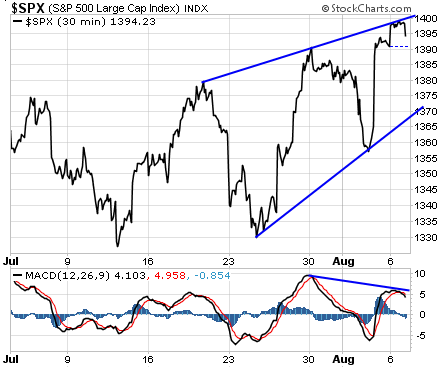
| It's happening again… the sneers, the nasty e-mails, the public ridicule… And that's just from my friends. "How's that big stock market decline working for you?" my friend Mark asked me yesterday. It's not working very well, of course. The S&P 500 has worked methodically higher since I started banging the caution drum a few weeks ago. The S&P 500 closed near 1,400 yesterday – up 2.5% in just the past month. So despite warning signs from the Volatility Index, the NYSE and Nasdaq Summation Indexes, and the McClellan Oscillator, owning stocks has been a profitable strategy. Hence, the public ridicule. Of course, that ridicule occurred back in April as well – when the market ground higher despite multiple caution signs. Eventually, the caution proved warranted… The S&P 500 dropped 9% in May and erased all of its gains for the year. The market is near the exact same condition today. So despite the nasty e-mails and sneers, I think it's best to err on the side of being too cautious right now. Please understand, I'm not bearish on stocks… I still think stocks will end the year slightly higher than where they are now. But jumping onboard the momentum train when the S&P 500 approaches its high for the year and a number of technical indicators turn bearish does not seem like a good strategy to me. Rather, it seems more prudent to use any hard declines as buying opportunities. And given the look of the following chart, we may be nearing the start of one of those hard declines right now… ![]() This is a 30-minute chart of the S&P 500 – which works best as a short-term timing tool. The index is tracing out a bearish rising-wedge pattern, and it is bumping up into the resistance line of the wedge. This resistance should at least cause a pause in the uptrend and a decline back toward the support line at about 1,370. Notice, however, the negative divergence on the MACD momentum indicator. While the S&P 500 has made a recent series of higher highs, the MACD indicator is still below its July 30 high-water mark. So the momentum behind this most recent rally is weakening. This is a good clue that the next move lower in the market might develop into more than just a small pullback toward support. It may end up retracing the entire move higher over the past two weeks… and challenge support at 1,330. Bulls will do better waiting to buy at that level rather than chasing the market higher right now. Best regards and good trading, Jeff Clark
My Two-Cents
I believe the trend has gone up too fast in a short period of time. Some consolidation will occur and the STI may drop back to the Horizontal support line and continue to climb up thereafter.
Nevertheless, I have already stated in my previous blog posts
that...
stock indexes all over the world will bounce back again! I still want to reiterate my point that the Worst is over, and even the not-so-bad news will push the markets up! Especially when i see from the forums everyone has the CASH vault ready.
You won't want to be missing from the Bull Run when everyone is pumping their available cash into equities!
Hope you like my post and can do me a favour by "Like"-ing my facebook page at www.facebook.com/kissinvesting. Thanks & HUAT AH!
|
4.8.12
Why Analyst Reports are Useless *Sakari and China Minzhong*
After suffering from a long decline... my stocks finally rebounded! So Happy that Patience works for Value Investing! *Sob*
Sakari Chart
China Minzhong
When you do Value Investing, the most important part is not to believe in hearsay or be affected by "Bombardment" from Analyst Reports.
Analyst Reports are there for the short term - Urging you to buy/sell quickly for them to earn commission, but not earn money for you! Lol..
Just to reiterate like what many Analyst Reports churn out Sakari Target Price hitting $1 or something and China Minzhong to hit $2.20 if you go browse through last year reports. To me, Analyst Reports are there created for people who don't believe in their own-selves.
According to a past research or experiment by the famous Straits Times Investing Section journalist lady (sorry i forgot her name), she generates Percentage Gain/Loss using various methods to Buy Stocks:
- PE Ratios
- Analyst Ratings
- Dividend Yield
- Any 2 more which i can't remember at the moment
I remembered that the % win was the LEAST for following the Recommendations by Broker Analyst Reports.
However, to say a word of fairness, Broker Analyst Reports are a source of timely and useful information right at your fingertips. It is vital that you absorb just the information but ultimately, you stick to your own judgement and pick the winning stocks according to your own methodology!
Hope you like my post and can do me a favour by "Like"-ing my facebook page at www.facebook.com/kissinvesting. Thanks & HUAT AH!
Subscribe to:
Posts (Atom)


.gif)